
The 2018 CrossFit Open season has almost come and gone. Although I tend to like training more than I like competing, I have joined hundreds of thousands others to compete in The Open. I enjoy it. In fact, I enjoy it so much that I watch a handful of strategy videos and spend a couple hours every week keeping up with who did well on the previous week’s workout. Of the many enjoyable parts of CrossFit, being able to compare your performance against the rest of the world, including the professionals, is one of the most enjoyable. However, there is at least one thing in the process I find excessive.
Every week, I watch the strategy videos and glean some important information. Advice on how to specifically warm up for the workout and how to orient your equipment for fast transitions is well received. Mostly, I am so excited about the workout that I just want to hear somebody talk about it. The part of the videos I find excessive is the talk about pacing. I get it that pacing is an important part of CrossFit, and that some general tips about how to break up reps during the workout may be helpful, but, since every workout and each person completing it is so unique, I think each workout is going to be completed largely by feel. It is probably a problem with me rather than the videos, but the more I listen to talk about workout pacing, the more I tend to overthink the workout. I do not truly know how I am going to break up the reps until I get in the workout.
For instance, 18.3 was a workout that contained a LOT of double unders, some muscle-ups, and a small amount of barbell/dumbbell work. It was hard to know exactly how that many double unders was going to affect your muscle-ups, and how both were going to affect the weighted movements. For instance, my grip was far more fatigued when I got to the ring muscle-ups than I expected, and my feet/calves were far more fatigued when I got to the dumbbell snatches than I expected. It may have helped a little to have heard someone share that experience, but that may not have been a problem for other people, and, regardless, my response was going to be the same even if I knew. I just needed to find a way to “move”.
CrossFit workouts are largely about staying moving. Whoever moves productively the most and rests the least, is probably going to earn a better score. Scientifically speaking, each person is trying to figure out how to be as productive as possible while staying aerobic for most of the workout.
The aerobic system is the biological system that uses oxygen to break down glucose into ATP in the mitochondrion:

A person, if properly trained, can use the aerobic system for a long time (definitely long enough for a CrossFit workout). If one wants to go faster than the aerobic system allows, he or she can only do it for a minute or two:
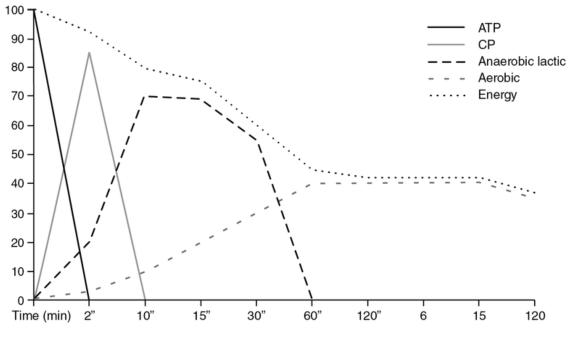
The graph shows how the ATP-CP system can produce a lot of power (90-100% maximum output) for about 8 seconds. The ATP-CP system works with the molecules that are already in your cells. The molecules don’t need to be made, they are just ready to go. This is largely why you can lift a lot of weight for 1 rep, but the weight drops considerably when you lift for 10, 20, or 30 reps.
If work is completed intensely for longer than 8 seconds, the anaerobic system will take over for a minute or two. The anaerobic system can use the carbohydrates that are in the cell’s cytoplasm and break them down without oxygen, but they produce lactic acid as a waste product, and lactic acid burns. This is why a 400m can be run very quickly and with great power (70-80% of maximum output), but it is also one of the most painful track events.
After a minute or two (some literature says anaerobic work can be done for 1 minute and others say up to 2 minutes), the power output must decline because the aerobic system must be used. The aerobic system can only provide about 50% of a person’s maximum output, and it requires oxygen be used in the cell’s mitochondrion. Since Open workouts typically last 7 to 20 minutes, CrossFitters largely live in the aerobic system.
Why does this matter?
Because, staying within the aerobic system demands a certain mindset. Have you ever pushed really hard for the first 2 minutes of a 10 minute workout and then spent the rest of the workout trying to figure out how to move without falling on the ground? This is probably because you used too much of the anaerobic system for the first 2 minutes and then spent the rest of the workout trying to clear the lactic acid that was produced. Instead, you should have focused on figuring out how to stay moving for the first 8 minutes of the workout and pushed for the last 2 minutes.
The science says that you can only push your anaerobic system for a maximum of 2 minutes, so you are fighting nature (and making yourself miserable) if you are trying to do more than that. Now, there are some people that can recover from anaerobic exercise very quickly. And there are some people that have such good aerobic systems that the power seems to be coming from the anaerobic system. But the best general strategy is to ride on the edge of your aerobic system until there are 1 to 2 minutes left in the workout and then empty your anaerobic system. When you are done with the workout, you can lay on the ground, walk around, or ride smoothly on the exercise bike to clear the lactic acid, but, during the workout, you don’t want to be trying to clear lactic acid and completing the work at the same time.
How does all this relate to pacing and, specifically, pacing in The Open? It all relates to what your mindset is going to be. I have found that the best aerobic cue for me is “move”. If I keep telling myself “move” throughout the workout, then I naturally find the aerobic pace for myself in that workout. If I am focusing on “moving”, I will not push myself into anaerobic territory, because my body knows that anaerobic now means I’ll pay for it with rest later.
But, I can’t just “move” for the whole workout. If I did that, I would be neglecting the power of the anaerobic system and leaving reps on the table. During 18.3, for instance, I focused on moving for the first 12 minutes of the workout. There was a 14 minute time cap, and I could complete the most work for the first 12 minutes by using my aerobic system. That doesn’t mean the hundreds of double unders were not painful, but they were not hands on my knees, gasping for air painful. Nor was I tripping on a bunch of double unders, because my breathing was out of control. Instead, I was trying my best to keep a steady, but fast, pace by telling my body to “move” as much as possible.
It wasn’t time to “push” until there were 2 minutes remaining. That is how long my anaerobic system could work, and it is why the 11 bar muscle-ups I ended the workout with were probably the most painful bar muscle-ups I have ever done, and why I spent 5 minutes lying on a bench after the clock hit 14:00. I made a conscious choice to only “move” during my last 100 double unders from 10:30-12:00, because I needed to be able to “push” when I got to the 12 bar muscle-ups. There was no reason for me to accumulate lactic acid during the double unders and then spend time clearing that on the bar muscle-ups.
This “moving” and “pushing” does not only apply to 18.3. In my 4.5 years of doing CrossFit, every workout follows a similar pattern: the most effective strategy is to move fast, but sustainably, for the first x minutes of the workout and push till it hurts in the last 2 minutes of the workout. If it is a 10 minute workout, I “move” for 8 minutes and “push” for 2 minutes. If it is a 4 minute workout, I “move” for 2 minutes and “push” for 2 minutes. If it is a 24 minute workout, I “move” for 22 minutes and “push” for 2 minutes. There is no guess work.
So, when a workout is set before me, the only real pacing decision is where the “push” line is. I recently did “Helen”:
3 Rounds
Run 400m
21 Kettlebell Swings (53/35)
12 Pull-ups
Based, on my fitness, I knew I could complete 200 meters of running, 21 kettlebell swings, and 12 pull-ups in about 2 minutes. Therefore, my best strategy was to “move” until I reached the last 200 meters of running, and then it was time to “push” with everything I had.
In “Open 18.2”, which was:
1-2-3-4-5-6-7-8-9-10
Double DB Front Squats (50/35)
Bar-Facing Burpees
The decision was to figure out where the “push” line was. In 18.2’s rep scheme, you are about half way done with the work after the round of 7 and hardly anyone was finishing the workout under 4 minutes. Therefore, I decided the best pacing strategy was to “move” for all the sets up to 7. At 7, I would check the clock and see what my projected finish would be. For instance, if I finished the rounds up to 7 in 2 minutes, I would know I was about 2 minutes from finishing the workout and it was time to “push”. In my case, I finished the round of 7 at about 3:20, therefore my projected finish was 6:40. As a result, it was time for me to “push” when the clock hit 4:40. To continue the example, if you finished the round of 7 at 5:00, you could know your projected finish was 10:00. Therefore, it would be wise for you to “push” at about 8:00.
In reality, the 18.2 example is one of the most complicated examples of when to “push”, because of the ascending rep scheme. When the workout is an AMRAP (as many reps as possible), just subtract 2:00 from the AMRAP time and you know when your body can “push”. If the workout is 4 rounds for time and you think each round is going to take you 4:00, then you “push” when you are halfway through the final round. The guess work is gone, and, hopefully, so is the standing around and heavy breathing that results from working too hard before it is anaerobic “push” time.
I’m going to keep watching The Open strategy videos, because I have a hard time fully satiating my appetite for CrossFit talk. I’m going to listen to what they say, but as soon as I start overthinking my pacing strategy, I am going to remind myself to find the point where 2 minutes remain in the workout. Once I find that point, I am going “move” until I hit it, and “push” until I am done. After the workout is over, I can have peace that I “moved” and “pushed” as much as my aerobic and anaerobic systems could possibly “move” and “push” that day.
 320 Gym
