5 Reasons for a Home Gym

Desk jobs mean sedentary lifestyles.  As our economies become more developed, planned exercise becomes more necessary.  A daily schedule that consists of driving to work (~30 minutes), sitting in an office chair (~8 hours), driving home from work (~30 minutes), and having a personal life (that is often sedentary) is not going to lead to health.  What is the solution to the sedentary lifestyles that have become a nagging companion of economic prosperity?  I think a piece of the solution are home gyms.  When the majority of the population works 40+ hours per week in an office, we desperately need convenient, meaningful, and enjoyable ways to get physical exercise.

I, personally, cannot see myself working out anywhere other than my home gym by choice.  I still use a couple other gym when I am looking to do something specific, but the home gym has so many perks, I don’t want to ever go long without one.  Among those perks are:

1. Convenience

This is absolutely the number one reason to have a home gym.  In fact, several of the other reasons to have a home gym link back to convenience.

It is no secret that rich countries are struggling with inactivity and obesity.  Our computers, cars, and other machines have made us wealthy.  We are living longer because of medical advances, but I don’t think anybody would argue we are more physically fit than our ancestors.  The majority of the population simply isn’t going to get physically fit from their occupations anymore.  Some sort of workout routine is necessary, but so is rest from the grind of traffic, job expectations, familial responsibilities, and everything else that demands time and energy.

If going to the gym requires driving 10-20 minutes, working out in front of people you don’t know, and paying a monthly membership, those are just extra reasons to forego a fitness routine.  When you consider it takes about 10 minutes to change for the gym, 10-20 minutes to drive there, and possibly 10 more minutes throughout the workout to navigate what equipment is available.  You are making at least an hour and a half commitment if you are exercising for 45 minutes and driving back home.  Such calculations make it more apparent why the majority of the population has a hard time committing to a consistent workout routine.

In contrast, consider how much more integrated a gym in your home can be to the rest of your life.  Instead of doing a full 45 minute to 1 hour gym session, you can use a home gym to do two 20 minute sessions or three 15 minute sessions.  Between the sessions, you can put dinner on, move laundry from the washer to the dryer, or feed your toddler a snack.  You could even do 20 minutes of exercise in the morning to get your day going and then 20 more minutes in the evening, if you choose.  When 30 minutes of driving and 10 minutes of navigating crowds are eliminated, working out seems far less daunting.

2. Cost

Now, the price tag of the equipment in 320 Gym is about $3,000, but we bought enough equipment for 2-3 people to workout at a time.  If you consider a minimum of 2 people getting use out of the gym for its lifetime, and a conservative cost of $60 per month for a CrossFit gym membership, $3,000 is worth the cost in approximately 25 months, or just over 2 years.  Even if one person is only using the gym and comparing it to a $30 per month gym membership, the gym will be worth the expense in 100 months, or 8 years and 4 months.  Considering, most worthwhile equipment to have is made of steel, and is being used less than 10 times per week, it is not a stretch to think you will get 10-20 years of use from barbells, kettle bells, pull-up bars, and squat racks.

None of these calculations include the money saved on transportation costs, nor do they consider the cost (financial or other) of taking up garage, basement, or other living space.  But, it doesn’t seem like a stretch to me to say these two variables cancel each other out.  Nor have we considered the possibility of having a gym for one, that could be done well for $1,000.  With 1 person using a $1,000 gym, the $60 membership would be more expensive in 17 months, or 1 year and 5 months, and the $30 membership would be more expensive in 34 months, or 2 years and 10 months.  The math is even more favorable if you live in an area with expensive gym memberships, or when you consider the fact that 2-4 people could realistically get use of $1,000 of gym equipment if they were smart about it.

3. Flexibility

Flexibility seems to be the same as convenience, and it somewhat is.  However, I am talking more about the flexibility of programming.  If you follow 320 Gym programming, then you will have a high degree of flexibility and reasonable level of structure.  This is important.  If left to ourselves, we will not always choose efficient ways to progress.  We will probably stay away from movements, loads, and conditioning workout durations that make us uncomfortable.  We also will probably not intuitively choose a strength program that builds intelligently.  However, it is also important to leave room for writing your own programming.  Without writing your own, you will not be as self-sufficient.  Nor will you be able to program your weaknesses consistently, or have the flexibility necessary to program around vacations, illnesses, life events, or work trips.

If you go to a CrossFit box, all of the programming will be done for you, and you will need to show up at a specific time to complete the workout with other people.  This can be good, because other people are motivating, and you need to be told what to do for a certain fraction of your life.  However, I don’t think that fraction should be 10/10, nor do I think having group classes at a specific time is the best recipe for most people getting into the gym 4-5 days per week.  A lot of people are too busy for that, or at least they think they are, and, when it comes to workout motivation, perception can be reality.

In contrast, if you go to a conventional gym, you have absolutely nobody giving you a plan, which is more flexible, but you also aren’t able to create unique conditioning workouts that allow you to complete multiple movements for a duration of time.  These circuit-style workouts are what CrossFit is known for, and is a way high levels of fitness can be developed in a short amount of time with lower levels of boredom.  In the conventional gym, you have the flexibility to do a lot of things in isolation, but you cannot conveniently use the exercise bike in close proximity to the pull-up bar and the Olympic lifting platform.  You do not have the flexibility to move equipment around as you please.  Nor do you have the flexibility to experiment with exercises, and combinations of exercises, without judgment.

4. Consistency

The first 3 reasons add up to the 4th reason:

Convenience + Low Cost + Flexibility = Consistency

Stories about people not being able to stick to workout routines are just as familiar as the depressing stories about obesity and physical inactivity.  Most people don’t like to exercise.  Exercise may be inconvenient, boring, too time consuming, difficult, embarrassing, or a combination of all.  I think most people’s formula is off.  Instead of the first formula I listed, most people’s formula is:

Inconvenience + High Cost + Inflexible = Inconsistency

Into the formula can also be inserted: poor results.  Regardless, a workout plan that is so convenient that you have to trip over the equipment to do other things, has costs that are sunk instead of monthly, and is flexible enough that you feel in control, but prescribed enough that you feel purposeful, is the best recipe for consistency.  Truly, this is a big reason why I put any work into this website.  I am looking for a workout plan that fits this formula:

Convenient + Low Cost + Flexible + Functional + Balanced + Measurable = Consistent Execution = Consistent Results

I know I threw in some extra variables, but the point is, I think a home gym takes care of a lot of the obstacles people have to consistently exercising, while the 320 Gym programming takes care of the exercise being functional, balanced, measurable, and therefore, meaningful.

5. Camaraderie

This may seem like an odd reason to workout at your house.  After all, if you stay at your house, how are you going to meet new people?  Granted, if you are looking to meet people, then working out in your home is certainly not the way to do that.  However, I would contend most people never get beyond surface level relationships with people they meet at the gym.  Now, there are always exceptions, and CrossFit boxes can create many more relationships that conventional gyms, but a home gym allows you to deepen relationships you already have.  Not only is the obesity and inactivity of the digital age well documented, so is the isolation resulting from many social media contacts but few deep physical relationships.

By working out at 320 Gym, I have a reason to go to my parents’ house 5 days per week.  As a 30 year old with my own home and responsibilities, this keeps me invested in the lives of my parents and younger siblings.  Among my younger siblings, I have a 23 year old brother that is mentally handicapped and loves watching us workout.  He always wants to know if Levi and I are coming over to workout, and, if he is home, he hangs out with us for almost all of our workout time.  He really enjoys heavy Olympic lifting.

Now, if you have a home gym, it is probably not going to keep you connected to your parents (but it might).  Instead, it is going to allow you to spend more time with your children or spouse.  Or, maybe, you’ll have a few buddies that come and workout with you.  Regardless, a home gym can allow you to spend more time with the people you love, and people you are pulled away from by work and other responsibilities.  If the gym is another responsibility that pulls you away from your children or spouse, that is just another reason for you to be inconsistent.

Conclusion

I know a home gym doesn’t work for everyone.  If you are a college student, an apartment dweller, or someone on a very limited budget, you may need to go to a conventional gym or use very limited equipment at home.  For those people, a home gym may be something to aspire too.  For everyone else, if you pay for a gym membership you barely use, or avoid working out because it simply isn’t convenient or enjoyable, you are spending money on things (memberships or future health bills) that could be going towards your own gym.  In this gym, you could be building health and memories with those you invite into the gym with you.

For those happy with their paid gym membership and consistently using it, thanks for listening!  This post wasn’t necessarily for you, but maybe you’ll have a time in your future when a home gym makes a lot more sense.

A home gym certainly is not the fitness silver bullet, nor are large gyms, CrossFit boxes, or health clinics, but I do think more home gyms could be a big step in the right direction.  And, like anything else, my home gym has been such a blessing to me, that my natural reaction is to try to share the merits with others.

Move then Push

The 2018 CrossFit Open season has almost come and gone.  Although I tend to like training more than I like competing, I have joined hundreds of thousands others to compete in The Open.  I enjoy it.  In fact, I enjoy it so much that I watch a handful of strategy videos and spend a couple hours every week keeping up with who did well on the previous week’s workout.  Of the many enjoyable parts of CrossFit, being able to compare your performance against the rest of the world, including the professionals, is one of the most enjoyable.  However, there is at least one thing in the process I find excessive.

Every week, I watch the strategy videos and glean some important information.  Advice on how to specifically warm up for the workout and how to orient your equipment for fast transitions is well received.  Mostly, I am so excited about the workout that I just want to hear somebody talk about it.  The part of the videos I find excessive is the talk about pacing.  I get it that pacing is an important part of CrossFit, and that some general tips about how to break up reps during the workout may be helpful, but, since every workout and each person completing it is so unique, I think each workout is going to be completed largely by feel.  It is probably a problem with me rather than the videos, but the more I listen to talk about workout pacing, the more I tend to overthink the workout.  I do not truly know how I am going to break up the reps until I get in the workout.

For instance, 18.3 was a workout that contained a LOT of double unders, some muscle-ups, and a small amount of barbell/dumbbell work.  It was hard to know exactly how that many double unders was going to affect your muscle-ups, and how both were going to affect the weighted movements.  For instance, my grip was far more fatigued when I got to the ring muscle-ups than I expected, and my feet/calves were far more fatigued when I got to the dumbbell snatches than I expected.  It may have helped a little to have heard someone share that experience, but that may not have been a problem for other people, and, regardless, my response was going to be the same even if I knew.  I just needed to find a way to “move”.

CrossFit workouts are largely about staying moving.  Whoever moves productively the most and rests the least, is probably going to earn a better score.  Scientifically speaking, each person is trying to figure out how to be as productive as possible while staying aerobic for most of the workout.

The aerobic system is the biological system that uses oxygen to break down glucose into ATP in the mitochondrion:

http://www.goldiesroom.org/Multimedia/Bio_Images/07%20Respiration/06%20Aerobic%20Respiration.JPG

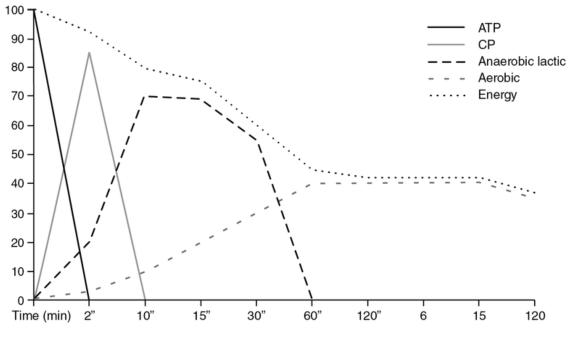
A person, if properly trained, can use the aerobic system for a long time (definitely long enough for a CrossFit workout).  If one wants to go faster than the aerobic system allows, he or she can only do it for a minute or two:

http://www.humankinetics.com/AcuCustom/Sitename/DAM/134/E6171_504810_ebook_Main.jpg

The graph shows how the ATP-CP system can produce a lot of power (90-100% maximum output) for about 8 seconds.  The ATP-CP system works with the molecules that are already in your cells.  The molecules don’t need to be made, they are just ready to go.  This is largely why you can lift a lot of weight for 1 rep, but the weight drops considerably when you lift for 10, 20, or 30 reps.

If work is completed intensely for longer than 8 seconds, the anaerobic system will take over for a minute or two.  The anaerobic system can use the carbohydrates that are in the cell’s cytoplasm and break them down without oxygen, but they produce lactic acid as a waste product, and lactic acid burns.  This is why a 400m can be run very quickly and with great power (70-80% of maximum output), but it is also one of the most painful track events.

After a minute or two (some literature says anaerobic work can be done for 1 minute and others say up to 2 minutes), the power output must decline because the aerobic system must be used.  The aerobic system can only provide about 50% of a person’s maximum output, and it requires oxygen be used in the cell’s mitochondrion.  Since Open workouts typically last 7 to 20 minutes, CrossFitters largely live in the aerobic system.

Why does this matter?

Because, staying within the aerobic system demands a certain mindset.  Have you ever pushed really hard for the first 2 minutes of a 10 minute workout and then spent the rest of the workout trying to figure out how to move without falling on the ground?  This is probably because you used too much of the anaerobic system for the first 2 minutes and then spent the rest of the workout trying to clear the lactic acid that was produced.  Instead, you should have focused on figuring out how to stay moving for the first 8 minutes of the workout and pushed for the last 2 minutes.

The science says that you can only push your anaerobic system for a maximum of 2 minutes, so you are fighting nature (and making yourself miserable) if you are trying to do more than that.  Now, there are some people that can recover from anaerobic exercise very quickly.  And there are some people that have such good aerobic systems that the power seems to be coming from the anaerobic system.  But the best general strategy is to ride on the edge of your aerobic system until there are 1 to 2 minutes left in the workout and then empty your anaerobic system.  When you are done with the workout, you can lay on the ground, walk around, or ride smoothly on the exercise bike to clear the lactic acid, but, during the workout, you don’t want to be trying to clear lactic acid and completing the work at the same time.

How does all this relate to pacing and, specifically, pacing in The Open?  It all relates to what your mindset is going to be.  I have found that the best aerobic cue for me is “move”.  If I keep telling myself “move” throughout the workout, then I naturally find the aerobic pace for myself in that workout.  If I am focusing on “moving”, I will not push myself into anaerobic territory, because my body knows that anaerobic now means I’ll pay for it with rest later.

But, I can’t just “move” for the whole workout.  If I did that, I would be neglecting the power of the anaerobic system and leaving reps on the table.  During 18.3, for instance, I focused on moving for the first 12 minutes of the workout.  There was a 14 minute time cap, and I could complete the most work for the first 12 minutes by using my aerobic system.  That doesn’t mean the hundreds of double unders were not painful, but they were not hands on my knees, gasping for air painful.  Nor was I tripping on a bunch of double unders, because my breathing was out of control.  Instead, I was trying my best to keep a steady, but fast, pace by telling my body to “move” as much as possible.

It wasn’t time to “push” until there were 2 minutes remaining.  That is how long my anaerobic system could work, and it is why the 11 bar muscle-ups I ended the workout with were probably the most painful bar muscle-ups I have ever done, and why I spent 5 minutes lying on a bench after the clock hit 14:00.  I made a conscious choice to only “move” during my last 100 double unders from 10:30-12:00, because I needed to be able to “push” when I got to the 12 bar muscle-ups.  There was no reason for me to accumulate lactic acid during the double unders and then spend time clearing that on the bar muscle-ups.

This “moving” and “pushing” does not only apply to 18.3.  In my 4.5 years of doing CrossFit, every workout follows a similar pattern: the most effective strategy is to move fast, but sustainably, for the first x minutes of the workout and push till it hurts in the last 2 minutes of the workout.  If it is a 10 minute workout, I “move” for 8 minutes and “push” for 2 minutes.  If it is a 4 minute workout, I “move” for 2 minutes and “push” for 2 minutes.  If it is a 24 minute workout, I “move” for 22 minutes and “push” for 2 minutes.  There is no guess work.

So, when a workout is set before me, the only real pacing decision is where the “push” line is.  I recently did “Helen”:

3 Rounds

Run 400m

21 Kettlebell Swings (53/35)

12 Pull-ups

Based, on my fitness, I knew I could complete 200 meters of running, 21 kettlebell swings, and 12 pull-ups in about 2 minutes.  Therefore, my best strategy was to “move” until I reached the last 200 meters of running, and then it was time to “push” with everything I had.

In “Open 18.2”, which was:

1-2-3-4-5-6-7-8-9-10

Double DB Front Squats (50/35)

Bar-Facing Burpees

The decision was to figure out where the “push” line was.  In 18.2’s rep scheme, you are about half way done with the work after the round of 7 and hardly anyone was finishing the workout under 4 minutes.  Therefore, I decided the best pacing strategy was to “move” for all the sets up to 7.  At 7, I would check the clock and see what my projected finish would be.  For instance, if I finished the rounds up to 7 in 2 minutes, I would know I was about 2 minutes from finishing the workout and it was time to “push”.  In my case, I finished the round of 7 at about 3:20, therefore my projected finish was 6:40.  As a result, it was time for me to “push” when the clock hit 4:40.  To continue the example, if you finished the round of 7 at 5:00, you could know your projected finish was 10:00.  Therefore, it would be wise for you to “push” at about 8:00.

In reality, the 18.2 example is one of the most complicated examples of when to “push”, because of the ascending rep scheme.  When the workout is an AMRAP (as many reps as possible), just subtract 2:00 from the AMRAP time and you know when your body can “push”.  If the workout is 4 rounds for time and you think each round is going to take you 4:00, then you “push” when you are halfway through the final round.  The guess work is gone, and, hopefully, so is the standing around and heavy breathing that results from working too hard before it is anaerobic “push” time.

I’m going to keep watching The Open strategy videos, because I have a hard time fully satiating my appetite for CrossFit talk.  I’m going to listen to what they say, but as soon as I start overthinking my pacing strategy, I am going to remind myself to find the point where 2 minutes remain in the workout.  Once I find that point, I am going “move” until I hit it, and “push” until I am done.  After the workout is over, I can have peace that I “moved” and “pushed” as much as my aerobic and anaerobic systems could possibly “move” and “push” that day.

5 Hours Per Week

I have been following CrossFit methodology for 4 years now.  Over those years, I have struggled through shoulder impingement, overtraining, and generally figuring out what the right dose of exercise is.  When I began, just as when beginning anything, the sky was the limit.  In the first 3 to 12 months of doing anything you do not know what your limitations are.  You have not done it enough to get a reliable sense of what sustainable growth looks like.  In the first year of doing CrossFit, it is easy to imagine adding 50 lbs to your bench press and taking 2:00 off your mile time in a mere 12 months.  In fact, it may happen, but the first 50 lbs and the first 2:00 are the easy gains.  This follows the principle that Josh Kaufman describes in his book “The First 20 Hours” and in this TED talk:

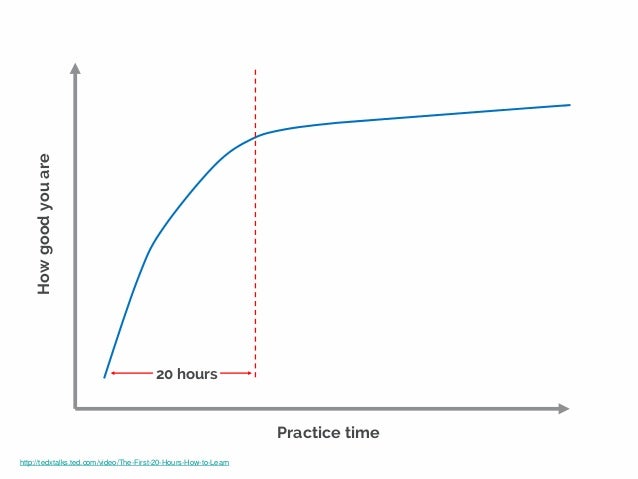
The premise is essentially this: while it takes many hours to become an expert at something, it make take only 20 hours of focused practice to become competent at something.  In fact, the first 20 hours are the time of greatest growth and adaptation:

Notice that beyond 20 hours more practice time continues to yield growth, the growth is simply slower.  For this reason, the first month or two of exercising can be the most exciting, because progress will be fast.  This is good, because it will hopefully hook you into a regular exercise routine.  However, without a proper understanding of how improvement works, you may overreach and have a hard time transitioning to a slower rate of growth.

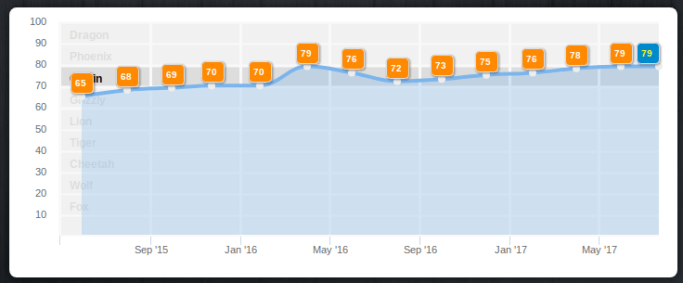
At some point, you are going to reach a point where you have to work fairly hard to have a little bit of growth.  You are going to be far enough into your practice time that your rate of growth is going to be slow no matter how hard you work.  Below is my Beyond the Whiteboard Fitness Level since I began using it in May 2015.

The data points are on 2 month intervals.  The level 79 and 76 from 2016 are outliers because they are from a time that I was not logging enough results to get a reliable fitness level.  When those are removed, a very steady trendline develops–I have grown by approximately 1 fitness level point every 2 months.  This is simply my rate of growth with the effort I could give over that time.  It would be great to accelerate this, but it is all my body is going to do with the 5 days per week I have to exercise.  Now, if I were able to go back to July 2013, when I began, I am sure I would have started somewhere in the 40s and I suppose I would have grown at a rate of 2-3 fitness level points every 2 months.  This was what my body was able to do early on in my development.

Why do I describe all this and how does it relate to 5 hours per week?  The point is this: you are going to reach a point in exercising where you are going to see slow growth.  Hopefully you are so genetically endowed that your slow growth doesn’t happen until your fitness level is in the 90s.  If this is the case, maybe you should continue pushing the limits and try to be competitive in the sport of fitness.  However, for most, you are going to hit a period of slow growth when your fitness level is in the 40s, 50s, 60s, or 70s.  How are you going to stay motivated during this time?  You should keep it fun and varied, work out with friends, and, mostly, just realize this is how it goes.  Your body can only get stronger and more conditioned at a certain rate.  You are not going to stay motivated by seeing significant gains all the time.  You are going to need to commit to a certain amount of time and enjoy the process.

For me, I could train 2-3 hours per day, 5 days per week, and maybe grow at 1.25-1.75 fitness level points every 2 months.  Or, I could train 1 hour per day, 5 days per week, and grow at 0.5-1 fitness level point every 2 months.  Where does each leave me?  I have pushed my limits enough to know that just 1.5-2 hours per day of hard training starts to rob from other areas of my life.  That 1.5-2 hours takes all the energy I have and all I want to do otherwise is lay around.  After 2 hours of hard training, I do not want to invest in relationships, read, cook, ride my bike, garden, play any other sports, or focus on anything that takes sustained effort.  In contrast, 1 hour seems to leave enough in the tank that I can do other things that require physical and mental effort.  In fact, that 1 hour can give me momentum to bring energy to other things in my life.  This is one reason why CrossFit has settled on 1 hour classes, and why founder Greg Glassman is credited with saying, “Past one hour, more is not better.

For the 99.9% of us that are not going to make a living exercising, we must aim for exercise that makes us fitter and better at life.  Through my years of trying to be fitter and better at life, 5 hours a week seems like a nice balance.  The workouts on 320 Gym are programmed with this in mind.  If you want to stretch for more, use the workout planning sheet to program your own, but if you simply give 5 hours per week to the workouts written, you should develop broad fitness that enriches rather than robs other areas of your life.